

BELL, George Maxwell “Max” (1911-1972)
George Maxwell “Max” Bell
Newspaper man, oil investor, horse racer, philanthropist
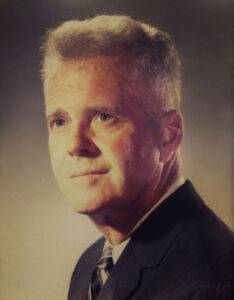 Born: October 13, 1911, in Regina, Saskatchewan
Married: Suzanne Staples
Died: July 19, 1972, in Montreal, Quebec
Buried: Okotoks Cemetery, area 1 sec 001 row A1 plot 01
Contributor: Ron Gilmore
Early life
George Maxwell Bell was born October 13, 1911, in Regina, Saskatchewan.His father earned his fortune selling insurance and owned several newspapers and periodicals before losing much of his wealth investing in mining and oil.
Bell earned a degree in commerce from Montreal’s McGill University during the Great Depression while working for his father at the Calgary Albertan newspaper during his summers. After graduating in 1932, Bell moved to British Columbia, where he unsuccessfully attempted to prospect for gold in the Kootenays for a time and played two seasons of senior hockey with the Kimberley Dynamiters. During this time, he met and married Suzanne Staples. The couple had four children.
Additionally, Bell invested in an oil well near Turner Valley, Alberta. When the well struck oil in mid-1936, the income from his one percent share was double that of his newspaper salary.
In 1946, Canadian oilman Frank McMahon and Bell started Alberta Distillers Limited in Calgary, Alberta.
Newspaper career
Under Bell’s leadership, the Albertan returned to profitability, almost immediately repaying his partners,
While he worked to regain control of the Albertan, Bell also continued to invest in oil ventures. In 1944, he partnered with Frank McMahon to form Calvan Petroleums on the heels of Imperial Oil‘s discovery of a large oil field at Redwater, Alberta. The company found success trading in leases and drilling rights on crown land, prompting Bell to form several other oil companies in the years that followed. In 1951, Bell amalgamated his various companies into Calvan Consolidated Ltd. The new company held an interest in 77 wells at the Redwater field. He sold Calvan to Petrofina in 1955 for $40 million.
Bell purchased the Victoria Times Colonist in 1959, and one year later built a plant to print both the Times and The Colonist, which he gained control of in 1953. In 1954, Bell acquired a controlling interest in the Lethbridge Herald. Bell continued to acquire newspapers, joining with Victor Sifton, owner of the Winnipeg Free Press, to purchase the Ottawa Journal in 1959. The pair combined their interests to form FP (Federated Paper) Publications Ltd. that same year. Bell purchased the Vancouver Sun in 1963 and Toronto’s The Globe and Mail in 1965, making FP Publications Canada’s largest newspaper syndicate.
By 1965, Bell was the largest single shareholder in Canadian Pacific Railway (CPR).
In addition to serving as a director for the CPR, Bell was also director for the Bank of Nova Scotia, a member of the board of governors of McGill University and a senior director of the Calgary Exhibition and Stampede.
Thoroughbred horse racing
Bell partnered with Frank McMahon to form Golden West Farms near Okotoks, Alberta.
Among his biggest victories, Bell won the 1965 Irish Derby, having sold one-third shares of ownership to McMahon and Bing Crosby just before the race. The horse then won two more races before being retired to stud.The horse, purchased by Bell for $9,000, won over $280,000 in purses before being sold for over $1.2 million.
Max Bell was inducted into the Canadian Horse Racing Hall of Fame in 1977.
Personal life
The family maintained a winter home in Palm Desert, California, and a ranch in Okotoks.
He neither drank nor smoked and was a generous donor to his church. He enjoyed playing golf and badminton, and frequently sailed his yacht, Campana, throughout the area around Vancouver Island. Bell was a supporter of organized sport at several levels and helped finance the Vancouver Canucks‘ entry into the National Hockey League, and was the original chairman of Hockey Canada when it began in 1968
Bell fell ill in 1967 and died on July 19, 1972, in Montreal. Before his death, he created the Max Bell Foundation and funded it with $17 million of FP Publications stock. In 50 years, the foundation’s assets had grown to $97 million in addition to over $97 million distributed as part of more than 500 grants across the nation. Max Bell Foundation has funded charities in a variety of areas since its inception, and currently focuses its grants on health, environment, education, and democracy and civic engagement.
Of course, in Calgary, the Max Bell Arena and the Max Bell Theatre are named after this business giant.
This information is courtesy of Wikipedia and the Max Bell Foundation.