

MCDOUGALL, Rev. George (1821-1876)
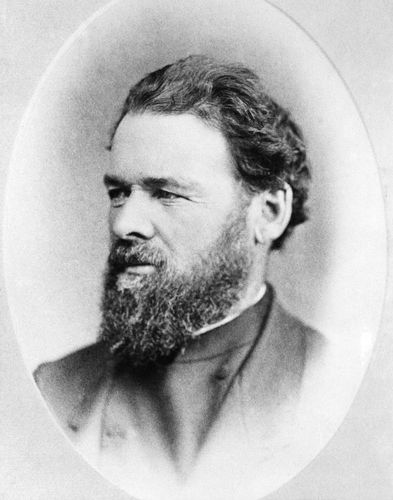 Rev. George Millward McDougall stands as one of the most influential missionary figures in the history of Western Canada, a man whose life intersected with the sweeping transformations of the mid‑19th‑century Prairies. His work unfolded during a period marked by the decline of the fur trade, the rise of Canadian expansionism, the increasing presence of settlers, and the profound upheavals faced by Indigenous nations. McDougall’s story is one of religious conviction, cultural negotiation, and personal sacrifice — culminating in a dramatic and tragic death that became part of Alberta’s early lore.
Early Life and Calling
Born on September 9, 1821, in Kingston, Upper Canada, George McDougall grew up in a region shaped by Loyalist settlement and Methodist revivalism. His family background exposed him early to the rhythms of frontier life and the fervour of evangelical Christianity. By his early twenties, he felt called to ministry and entered the Methodist Episcopal Church, beginning his pastoral work in Ontario communities.
McDougall’s early ministry was conventional by Methodist standards: circuit riding, preaching in scattered settlements, and supporting the growing network of Wesleyan congregations. Yet he soon developed a strong interest in missionary work, particularly among Indigenous peoples. This interest aligned with the Methodist Church’s expanding mission strategy, which saw the West as both a spiritual field and a region of national importance.
Transition to Western Missions
In 1860, McDougall accepted an appointment to the Rossville Mission at Norway House, a major Hudson’s Bay Company hub in the northern interior. This move marked a decisive shift in his life. The West was undergoing rapid change: the buffalo herds were declining, the Hudson’s Bay Company’s influence was weakening, and Indigenous nations were navigating new pressures from disease, trade disruptions, and political uncertainty.
At Norway House, McDougall worked among Cree and Métis communities, learning the complexities of local relationships and the challenges of missionary life in the northern forest and lake country. His leadership abilities quickly became evident, and in 1862 he was appointed superintendent of Methodist missions in the Saskatchewan District — a vast territory stretching across the plains.
Mission Work on the Prairies
McDougall’s next major posting was at Victoria Mission on the North Saskatchewan River, founded by his son, Rev. John McDougall, and Methodist missionary Henry Steinhauer. Victoria became a centre of Methodist activity, serving Cree communities and Métis families along the river. McDougall’s work involved preaching, teaching, mediating disputes, and supporting agricultural training — part of the Methodist belief that Christianity and settled farming could help Indigenous communities adapt to the changing world.
He travelled constantly, often covering hundreds of kilometres by horse, canoe, or snowshoe. His journals and letters describe long journeys through storms, encounters with buffalo hunters, and negotiations with chiefs and traders. McDougall was known for his energy and persistence, traits that earned him respect even among those who disagreed with missionary goals.
Diplomacy and Advocacy
The 1860s and early 1870s were a period of rising tension on the Plains. The disappearance of the buffalo threatened the livelihoods of Cree, Blackfoot, Stoney Nakoda, and other nations. Intertribal conflicts increased as hunting territories shrank. At the same time, the Canadian government — having acquired Rupert’s Land from the Hudson’s Bay Company — sought to extend its authority westward.
McDougall often found himself in the role of intermediary. He advocated for peace between Indigenous nations, urging restraint during periods of conflict. He also communicated Indigenous concerns to government officials, though always through the lens of his missionary worldview.
His relationship with the Stoney Nakoda people became particularly strong. In 1873, he helped establish the Morleyville Mission (near present‑day Morley, Alberta), which became a focal point for Methodist work in the foothills. Morleyville served as a school, church, and meeting place, and it became the McDougall family’s home base.
Role in Treaty Negotiations
As the Canadian government prepared to negotiate treaties across the Prairies, missionaries — including McDougall — played influential roles. Although he was not an official treaty commissioner, McDougall supported the government’s efforts to secure agreements, believing treaties would provide stability and open the way for mission expansion.
His involvement remains debated by historians. Some view him as a sincere advocate for Indigenous welfare, urging the government to provide food, education, and medical support. Others argue that missionaries, including McDougall, encouraged Indigenous leaders to accept treaties without fully understanding the long‑term consequences. What is clear is that McDougall saw treaties as part of a broader civilizing mission, consistent with Methodist ideology of the time.
Family Legacy
George McDougall’s family played a central role in his work. His wife, Elizabeth Chantler McDougall, was a formidable partner, managing mission households, teaching, and supporting community life. Their children — particularly John and David — became prominent missionaries and interpreters in their own right.
John McDougall, the eldest son, became one of the best‑known figures in early Alberta history. Fluent in Cree and Stoney languages, he served as a guide, interpreter, and negotiator during Treaty 6 and Treaty 7 discussions. His memoirs later shaped public memory of the missionary era, including accounts of his father’s final days.
The Final Journey and Tragic Death
In January 1876, George McDougall was at Morleyville during a period of intense cold. A group of horses had gone missing — a serious loss in winter on the frontier — and McDougall joined a search party heading toward the foothills near Ghost Lake.
The weather was severe, with deep snow and plunging temperatures. During the search, McDougall became separated from the others. Accounts suggest he may have followed tracks into a coulee or attempted to circle back to camp. When he did not return, a larger search was organized.
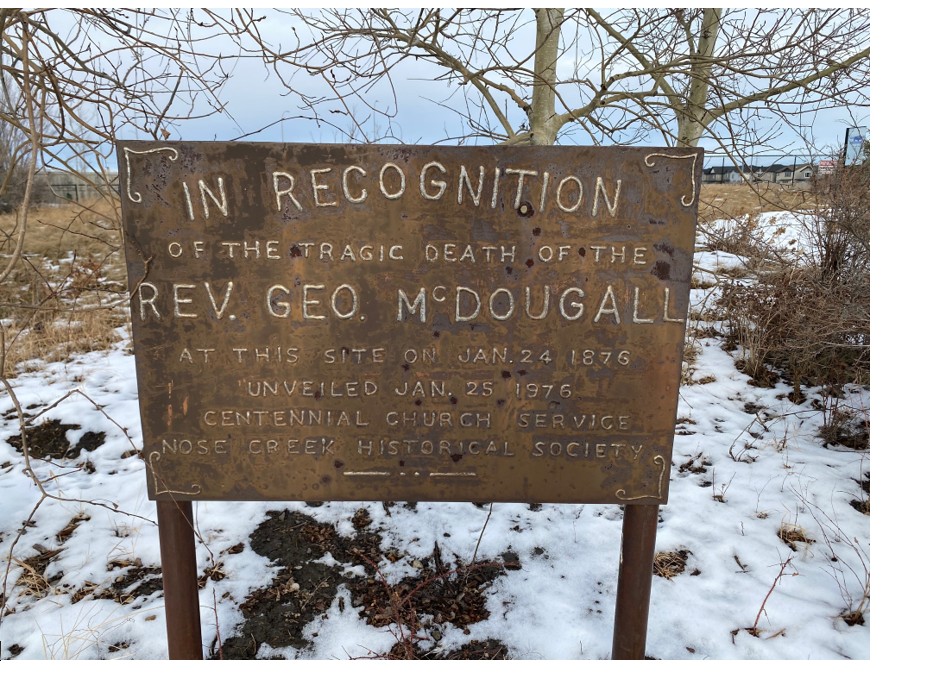
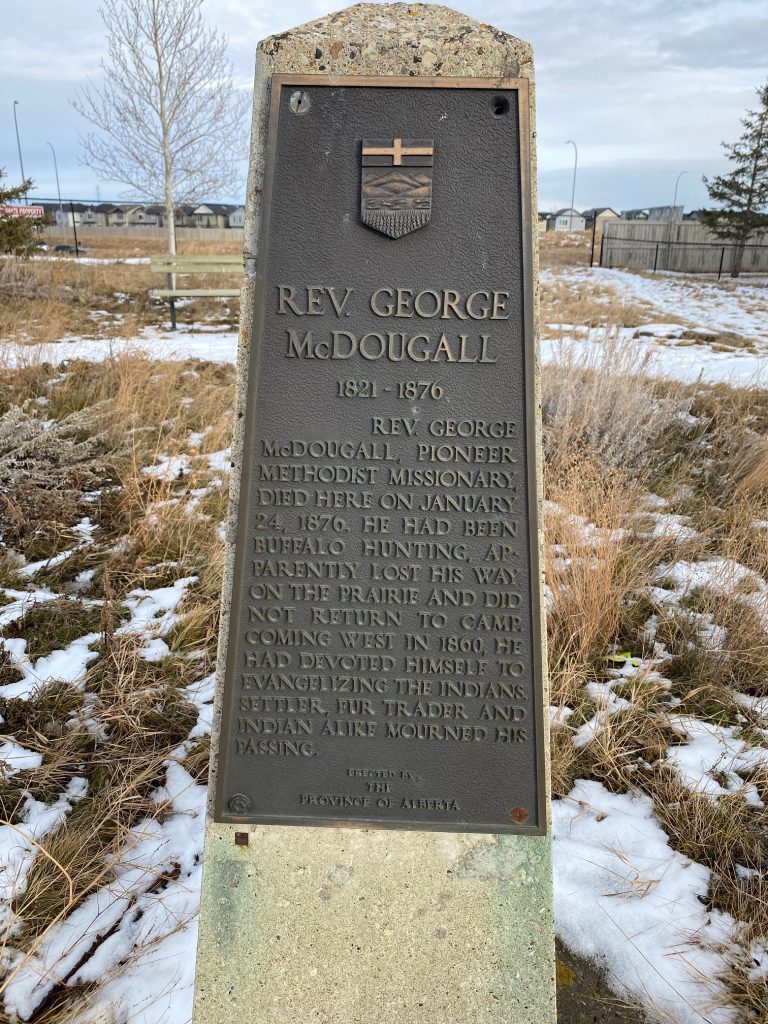
His body was found days later, frozen on the open prairie. The exact circumstances remain uncertain, but exposure and exhaustion were the likely causes. His death sent shockwaves through mission communities and Indigenous nations alike. For many, it symbolized the harshness of frontier life and the personal risks missionaries accepted.
The location of Rev. McDougall’s place of death is marked by a plaque and a concrete obelisk market in north Calgary, just south and west of Stoney Trail and 14th Street, N.W. The plaque is a stainless-steel plate with narrative by welding marks. There is a pathway from a street to the markers on a small rise containing original prairie grass.
Legacy in Western Canada
Rev. George McDougall’s influence extended far beyond his lifetime. His missions became centres of community life, education, and diplomacy. Morleyville, in particular, evolved into a key Methodist outpost and later a historic site. His descendants continued his work, shaping early Alberta’s religious and cultural landscape.
His legacy is complex, reflecting both the humanitarian intentions and the colonial assumptions of 19th‑century missionary work. He sought to support Indigenous communities during a time of crisis, yet he also promoted cultural transformation aligned with Canadian expansion. Modern historians and Indigenous scholars continue to reassess his role, acknowledging both his contributions and the broader impacts of missionary activity.
What remains undeniable is that McDougall was a central figure in the story of Western Canada’s transition from fur‑trade frontier to a region of treaties, missions, and settlement. His life embodied the tensions, hopes, and tragedies of that era.